From constraint models to playable puzzle gamesDRAFT
For my paper Scaling Sudoku as a Constraint Problem, I generated a repository of 434,201 Sudoku instances at five sizes between 6×6 and 36×36. I used them in constraint-programming experiments to ask which propagation scheme solves a puzzle without branching, how that changes with size, and how many clues move an instance from one hardness category to another.
I also wanted to play a few of them.
That small wish grew sideways. I now have playable versions of Sudoku, Nonogram, Queens, Zip, Loopy, Tents, Patches, Wend, and its Swedish sibling Swend, all collected on a games page.
For each game, I have included a small model written in MiniZinc, a constraint-modelling language, and picked out one part of the generator to explain. These are explanatory sketches, not the programs that build the packs. Most of the generation and solving code uses Gecode 6.4.0, with separate programs for importing, rasterisation, exact cover, and pack assembly.
All nine games start with a solution or source image. I add, move, or remove information until the intended answer is unique, or discard the candidate if it cannot be repaired cleanly. Some of the deductions used along the way later classify difficulty and provide hints.
Generation and uniqueness checking happen offline. The browser receives static puzzles and stored solutions. It never runs a solver. Difficulty labels come from propagation, search, or deterministic deduction measurements. The labels order puzzles within a pack; they are not estimates of how difficult people will find them.
I checked the listings with MiniZinc 2.10.0. They leave out input validation, search annotations, and the outer loop that rejects a candidate when a second solution exists. I also omitted output except where it defines which decisions count as a puzzle solution.
Sudoku: from corpus to game
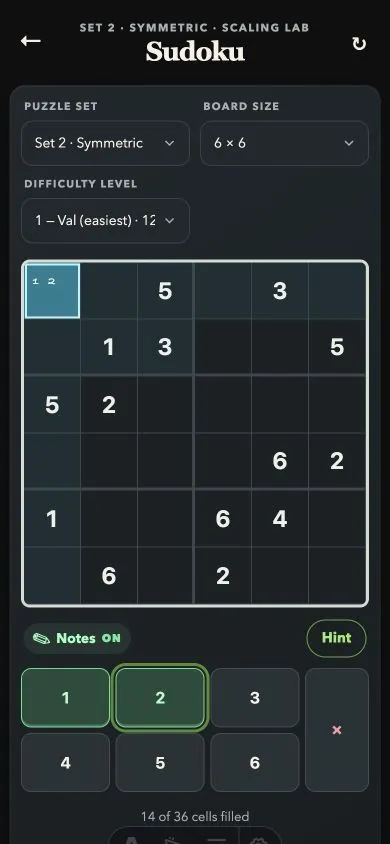
The Scaling Sudoku corpus begins with 32,000 uniquely solvable base puzzles at sizes 6×6, 9×9, 16×16, 25×25, and 36×36. A generator first creates a complete grid, then removes clues while preserving uniqueness. Gecode classifies the resulting puzzles.
The classification extends the setup in Helmut Simonis’s 2005 paper Sudoku as a Constraint Problem. It tries an ordered family of propagation configurations. Val, Bnd, and Dom refer to value, bounds, and domain propagation; BS and DS add bounds or domain shaving.1 The weakest successful configuration becomes the puzzle’s hardness tag. If none finishes without branching, the tag is Search.
The basic Sudoku model is pleasantly short. The box dimensions are data, which lets the same model handle 6×6 boards with 2×3 boxes and the usual 9×9 boards with 3×3 boxes.
include "globals.mzn";
int: n;int: box_height;int: box_width;set of int: N = 1..n;set of int: Values = 1..n;set of int: BoxTopRows = {  row | row in N where (row - 1) mod box_height = 0};set of int: BoxLeftColumns = {  column | column in N where (column - 1) mod box_width = 0};
array[N, N] of 0..n: clue;array[N, N] of var Values: board;
constraint forall (row in N) (  all_different(board[row,..]));constraint forall (column in N) (  all_different(board[..,column]));
constraint forall (top in BoxTopRows, left in BoxLeftColumns) (  all_different(board[      top..top+box_height-1,      left..left+box_width-1  ]));
constraint forall (row, column in N where clue[row,column] > 0) (  board[row,column] = clue[row,column]);
solve satisfy;
The playable pack is a reproducible, fixed-seed sample of 500 base puzzles from a pinned corpus revision, limited to 6×6 and 9×9 boards. An offline importer turns the selected puzzles and their known solutions into a static pack.
Making Sudoku look more like Sudoku
Generated puzzles do not automatically have the visual symmetry people expect from a published Sudoku. I did not want to generate a separate collection just for presentation, so I wrote an offline symmetrification pass for the selected puzzles.
The pass can make two kinds of change. It can permute rows and columns while preserving the box structure, including rows within a band, columns within a stack, and the bands and stacks themselves. It can also fill a missing rotational partner with the value from the known solution. Adding a clue cannot introduce a second solution, though it may make the puzzle easier according to the propagation classifier.
The clue pattern starts out asymmetric.
First, columns 5 and 6 swap within the right stack.
Then the middle and lower two-row bands swap places.
The first new clue stays marked in green while its existing rotational partner pulses.
The second new clue is marked and its existing partner pulses.
The third marked clue completes the last pair.
The finished clue pattern has 180° rotational symmetry.
For each puzzle, the optimiser enumerates the distinct rotational pairings available through box-preserving layouts. It ranks them by the number of clues needed for 180-degree rotational symmetry and evaluates the best three. For each layout, it first tries completing the symmetry. If that changes the hardness tag, it adds partner clues one at a time and keeps only those for which Gecode reproduces the original tag. It then chooses the result with the fewest asymmetric cells.
The pass made 228 of the 500 puzzles exactly rotationally symmetric and reduced the total number of asymmetric cells from 6,172 to 1,928.
Nonogram: back to regular
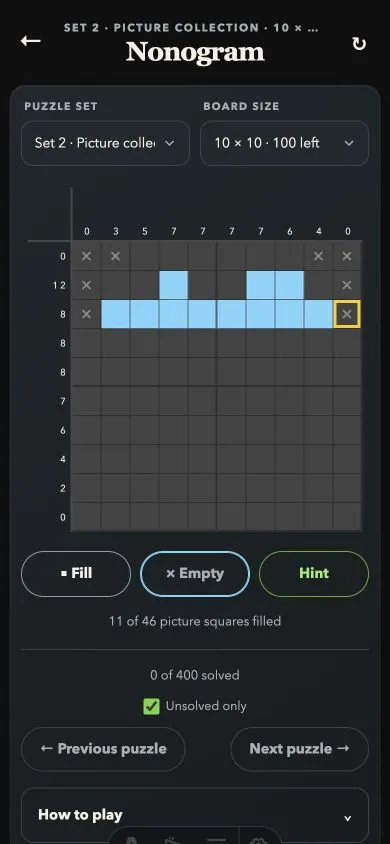
In a Nonogram, the player fills cells so that the runs in every row and column match the given clues. This game takes me back to my early Gecode work. In 2005, I wrote the original Gecode nonogram example using Gilles Pesant’s regular constraint. The model describes a line with runs of lengths a, b, ..., z by the regular expression
0* 1^a 0+ 1^b 0+ ... 0+ 1^z 0*
where 1 is a filled square and 0 is an empty one. Gecode turns the expression into a finite-state machine and constrains every row and column to follow it. The Gecode 6.4.0 example still uses the same compact idea.
Jan Wolter later included the example in his extensive survey of Paint-by-Number solvers. I rather liked his assessment. This small demonstration model performed surprisingly well alongside much larger, specialised solvers.
The MiniZinc model builds and applies the same automata directly. Its run clues are lists, so rows and columns can contain different numbers of runs without padding. The function line_regexp builds a regular-expression string from each list. MiniZinc compiles that string to a finite-state machine, and regular applies it to a row or column.
include "globals.mzn";
enum CellStates = {Empty, Filled};int: rows;int: columns;set of int: Rows = 1..rows;set of int: Columns = 1..columns;
array[Rows] of list of int: row_runs;array[Columns] of list of int: column_runs;
array[Rows, Columns] of var CellStates: board;
function string: line_regexp(list of int: runs) =  "Empty* " ++  join(" Empty+ ", [      "Filled{" ++ show(run) ++ "}" | run in runs  ]) ++  " Empty*";
% Runs [3, 2] become% "Empty* Filled{3} Empty+ Filled{2} Empty*"
constraint forall (row in Rows) (  regular(      board[row,..],      line_regexp(row_runs[row])  ));
constraint forall (column in Columns) (  regular(      board[..,column],      line_regexp(column_runs[column])  ));
solve satisfy;
A newer icon pack starts with SVGs from the pinned Heroicons 2.2.0 and Phosphor Icons 2.1.1 archives. An offline rasteriser renders each icon at high resolution, fits it to one of four board sizes, and thresholds the result into filled and empty cells.
Source iconHeroicons SVG

Rasterize and trimmagnified preview
Resize and threshold10×10 puzzle bitmap
Each source icon is assigned to one board size, so the same image cannot reappear at several resolutions. The selector rejects rasters with extreme fill ratios, too many connected components, duplicate fingerprints, or badly balanced clues. Among the remaining images, it favours silhouettes that were reviewed or retain more detail. The imported bitmap must satisfy the derived clues, and Gecode must find no second solution.
A deterministic replay records the initial line ambiguity and largest initial candidate set, then measures deduction rounds and unresolved cells. Together with Gecode’s search nodes and failures, these measurements rank the valid instances within each size.
Queens: grow regions around a solution
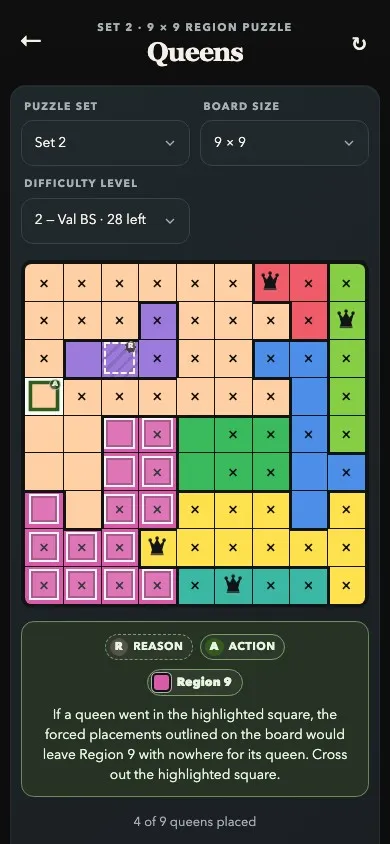
Queens is the one-star form of Star Battle. The player places one queen in every row, column, and coloured region, with no two queens touching. The generator starts with a valid no-touch queen permutation and grows one orthogonally connected region from each queen. It then moves non-queen cells along region boundaries while preserving connectivity.
The small example below starts with the base solution, then adds the proposed region boundaries. Those boundaries also admit a second solution, so the puzzle is not yet valid. Moving the cell marked M into the neighbouring region removes the alternative. That single boundary move makes the intended solution unique. The real generator repeats this kind of change, checking region connectivity and stopping each solution count at two.
One variable per row is enough for the puzzle model. Its value is the queen’s column. Distinct columns handle the column rule, while indexing the region matrix at each queen position handles all coloured regions at once.
include "globals.mzn";
int: n;set of int: N = 1..n;enum Regions;
array[N, N] of Regions: region;array[N] of var N: board;
% Each queen is in a different columnconstraint all_different(board);
% Each queen is in a different regionconstraint all_different (row in N) (  region[row, board[row]]);
% Queens in neighbouring rows may not touch diagonallyconstraint forall (row in 1..n-1) (  abs(board[row] - board[row+1]) > 1);
solve satisfy;
Region relabellings and the eight rotations and reflections of a square board are reduced to one canonical fingerprint. This prevents disguised copies of the same puzzle. The generator also limits tiny and dominant regions, using limits I chose after measuring published LinkedIn Queens boards. Difficulty is classified using the same propagation and shaving configurations as Scaling Sudoku, followed by Search when none solves the board without branching.
Zip: ask for a counterexample
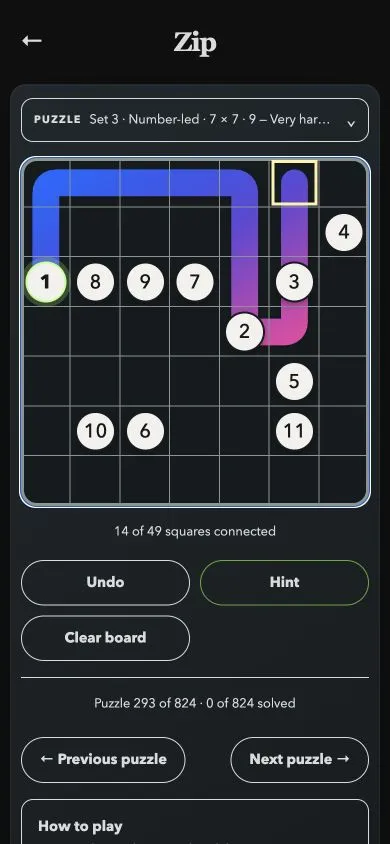
In Zip, the player draws one path through every cell while visiting numbered clues in order and avoiding hedges. The generator represents that path as a Gecode circuit. Each board cell has a successor, and an extra return node connects the final clue back to clue 1. The circuit constraint rules out disconnected subtours. Inverse path and position views make the numbered ordering constraints explicit.
The model expresses orthogonal movement with row and column offsets, trying all four directions for each cell. MiniZinc’s default <> turns an out-of-bounds lookup into an absent cell. An absent cell cannot equal the successor, so directions outside the board disappear from the disjunction. The model needs no separate adjacency matrix.
include "globals.mzn";
int: rows;int: columns;int: cells = rows * columns;set of int: Rows = 1..rows;set of int: Columns = 1..columns;set of int: Cells = 1..cells;set of int: Nodes = 1..cells + 1;int: return_node = cells + 1;
enum Directions = {Up, Right, Down, Left};array[Directions] of int: row_offset = [-1, 0, 1, 0];array[Directions] of int: column_offset = [0, 1, 0, -1];array[Rows, Columns] of Cells: board =  array2d(Rows, Columns, [cell | cell in Cells]);
array[Cells, Cells] of bool: hedge; % Symmetricint: number_count;array[1..number_count] of Cells: numbered_cell;
array[Nodes] of var Nodes: successor;array[Cells] of var Cells: path;array[Cells] of var Cells: position;
constraint circuit(successor);constraint inverse(path, position);
constraint successor[return_node] = numbered_cell[1];constraint successor[numbered_cell[number_count]] = return_node;constraint forall (  row in Rows,  column in Columns  where board[row,column] != numbered_cell[number_count]) (  let {Cells: cell = board[row,column]} in  exists (direction in Directions) (      successor[cell] =          (board[              row + row_offset[direction],              column + column_offset[direction]          ] default <>)  ) /\  not hedge[cell,successor[cell]]);
constraint path[1] = numbered_cell[1];constraint path[cells] = numbered_cell[number_count];constraint forall (step in 1..cells-1) (  successor[path[step]] = path[step+1]);constraint forall (number in 1..number_count-1) (  position[numbered_cell[number]] < position[numbered_cell[number+1]]);
solve satisfy;
To decide which numbers and hedges to show, the Zip generator begins with only the first and last numbers. It asks the solver for a second path, then uses that counterexample to choose the next clue. The example below starts after one checkpoint has already been added. Both paths obey the visible clues 1, 2, and 3.
The added clue says that the middle-left cell must occur after the top-middle one. This holds for the intended path but not the counterexample, so the clue removes that ambiguity. The generator repeats this whenever possible, adding a numbered checkpoint whose position distinguishes the two paths. Sometimes it needs a pair of numbers because the paths visit those cells in opposite orders. It adds a hedge only when numbers cannot separate the counterexample within the clue-density limit.
This continues until the intended path is the only solution. Limits on numbers and hedges keep the board from filling with annotations.
Zip tries the same nine propagation and shaving configurations as Scaling Sudoku, followed by Search when none solves without branching. The interface maps the ten internal tags to relative labels from Gentle through Expert.
Loopy: hide clues from a finished loop
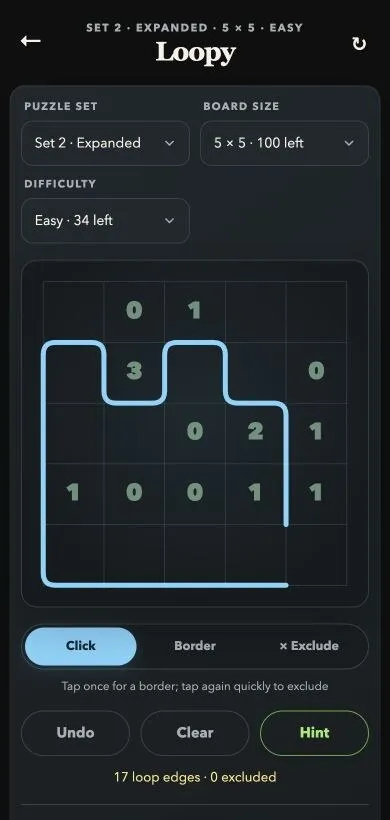
Loopy is played on the edges of a square grid. The aim is to draw one closed loop without branches or crossings. A number inside a cell tells the player how many of its four edges belong to the loop; a blank cell imposes no such count.
The generator begins with the loop. It grows a connected patch of cells while keeping the cells outside the patch connected, then rejects any boundary that is not one simple loop. Once the shape is fixed, counting the four surrounding loop edges for every cell gives a fully clued puzzle.
The MiniZinc model assigns one successor variable to each grid vertex. A vertex outside the loop points to itself. The remaining successors form one directed cycle, which is exactly the structure captured by subcircuit. An undirected grid edge belongs to the loop when either endpoint chooses the other as its successor.
include "subcircuit.mzn";
enum Cells;enum Vertices;enum Edges;enum Sides = {North, East, South, West};
array[Cells] of opt 0..3: clue;array[Cells, Sides] of Edges: cell_edge;array[Edges] of Vertices: edge_from;array[Edges] of Vertices: edge_to;
array[Vertices] of set of Vertices: neighbour = [  {edge_to[edge] | edge in Edges where edge_from[edge] = vertex} union  {edge_from[edge] | edge in Edges where edge_to[edge] = vertex}  | vertex in Vertices];
array[Vertices] of var Vertices: successor;
constraint forall (vertex in Vertices) (  successor[vertex] = vertex \/  successor[vertex] in neighbour[vertex]);constraint subcircuit(successor);constraint exists (vertex in Vertices) (  successor[vertex] != vertex);
% An undirected edge cannot be traversed in both directions.constraint forall (edge in Edges) (  not (      successor[edge_from[edge]] = edge_to[edge] /\      successor[edge_to[edge]] = edge_from[edge]  ));
array[Edges] of var bool: in_loop = [  successor[edge_from[edge]] = edge_to[edge] \/  successor[edge_to[edge]] = edge_from[edge]  | edge in Edges];
constraint forall (cell in Cells where occurs(clue[cell])) (  sum (side in Sides) (in_loop[cell_edge[cell, side]]) =      deopt(clue[cell]));
solve satisfy;
% Puzzle solutions are undirected edge sets, not cycle orientations.output [show(in_loop)];
The additional edge constraint rules out a directed two-cycle between adjacent vertices, which would otherwise collapse to a single undirected edge rather than a loop. The output records only in_loop, and the omitted uniqueness loop blocks each discovered edge set. It therefore treats the two directed orientations as the same puzzle solution.
A fully clued board is a useful starting point but a poor puzzle. The generator hides clues one at a time, keeping a clue hidden only if the intended loop remains unique. For an Easy or Medium candidate, the local deduction engine also checks that the puzzle stays within the requested band.
Difficulty is measured by replaying two families of local deductions. A satisfied clue excludes its remaining edges, while a clue that needs every undecided edge forces them into the loop. At a grid vertex, two loop edges exclude the other incident edges. One loop edge with only one undecided incident edge forces that edge into the loop. With no selected loop edges and only one undecided incident edge, that edge is forced out. The bands record how many deduction rounds are needed. Every selected puzzle can be completed by these rules without search.
Tents: move the trees against an alternative
In Tents, the player places one orthogonally adjacent tent for each tree. No two tents may touch, even diagonally, and the row and column clues give the number of tents in each line. The generator starts from those tents, assigns each one a distinct orthogonally adjacent tree, and derives the counts. Those clues often admit another tent set.
The useful counterexample consists of the alternative tent set and one possible matching to the trees. When the intended answer is not unique, the generator moves one tree to another square beside its intended tent. It chooses a square that prevents the alternative tents from matching every tree. The tent set and line counts stay fixed. After each move, the generator counts the solutions again and stops when only the intended tent set remains. In the example below, dashed lines show one matching between trees and tents, while M marks the moved tree.
The MiniZinc sketch does not need a decision variable for every board cell. A Coordinate record keeps a row and column together, and each tree has one such decision record for its tent. Whole-array field projections such as tents.row let global_cardinality count the chosen rows and columns directly. Optional lookups handle the board edges, imaginary 2×2 squares enforce tent spacing, and sorted output identifies a solution by its tent set rather than by a particular tree-to-tent matching.
include "globals.mzn";
int: rows;int: columns;set of int: Rows = 1..rows;set of int: Columns = 1..columns;set of int: Cells = 1..(rows * columns);enum Trees;
type Coordinate = record(Rows: row, Columns: column);
array[Trees] of Coordinate: trees;array[Rows] of 0..columns: row_count;array[Columns] of 0..rows: column_count;
array[Rows, Columns] of Cells: cell_id =  array2d(Rows, Columns, [cell | cell in Cells]);array[Trees] of var Coordinate: tents;array[Trees] of var Cells: tent_cells = [  cell_id[tents[tree].row, tents[tree].column]  | tree in Trees];
% Each tree chooses an orthogonally adjacent cell that is not a tree.constraint forall (tree in Trees) (  not (tents[tree] in trees) /\  exists (      row_offset, column_offset in -1..1      where abs(row_offset) + abs(column_offset) = 1  ) (      tent_cells[tree] =          (cell_id[              trees[tree].row + row_offset,              trees[tree].column + column_offset          ] default <>)  ));
% diffn also makes the cells distinct, but the explicit all_different% gives the tree-to-tent matching its own Hall-style propagator.constraint all_different(tent_cells);
% Count the tent rows and columns directly.constraint global_cardinality(  tents.row,  [row: row | row in Rows],  row_count);constraint global_cardinality(  tents.column,  [column: column | column in Columns],  column_count);
% Two 2 by 2 squares overlap exactly when their anchor cells touch.constraint diffn(  tents.row,  tents.column,  [tree: 2 | tree in Trees],  [tree: 2 | tree in Trees]);
solve satisfy;
% Puzzle solutions are tent sets, not particular tree/tent matchings.output [show(sort(tent_cells))];
The parameter array cell_id is only a coordinate lookup. The adjacency constraint uses the same default <> boundary idiom as Zip. Strict equality cannot match the absent value returned outside the board, so the four offsets need no edge cases.
diffn normally keeps rectangles from overlapping. Here each tent anchors an imaginary 2×2 square. Two such squares overlap exactly when their anchor cells coincide or touch along an edge or corner, so one global constraint replaces the eight-neighbour decomposition. This also makes the tent cells distinct. The explicit all_different is logically redundant, but it exposes the one-to-one matching to a dedicated matching propagator. The imaginary squares may extend past the board. Without a container constraint, diffn only constrains them relative to each other.
The sorted output is deliberate. Since tents is indexed by tree, one tent set can admit several tree-to-tent matchings. The omitted uniqueness loop blocks the sorted cell identifiers, so it counts player-visible tent sets rather than matching witnesses. The native generator uses the same identity when it asks whether a second solution exists.
The player-facing Easy, Medium, and Hard labels come from replaying the deterministic deductions used by the hint engine. Easy puzzles use line-count and tent-spacing deductions, grass marks for cells without an adjacent tree, and trees with a single remaining position. Medium adds locked tree sets and one-to-one matching deductions. Hard requires a short failed assumption. The engine tries a tent or grass mark, propagates, and rejects the assumption if it reaches a contradiction.
Empty lines are useful clues, but too many produce striped boards with large inactive areas. The generator therefore sets separate limits on empty rows and empty columns.
Patches: remove information from a tiling
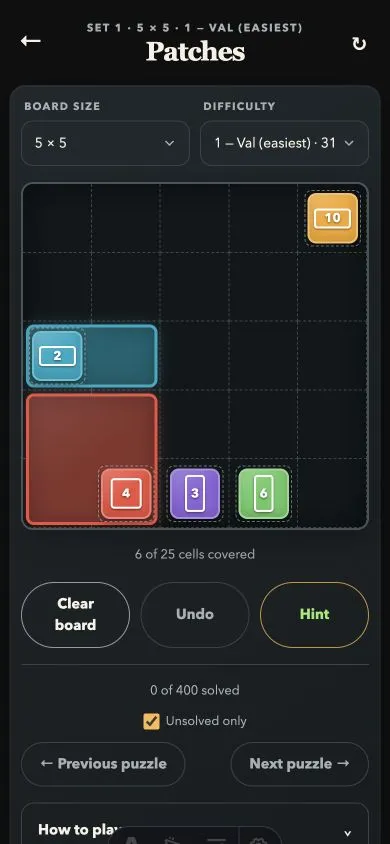
Patches asks the player to divide the board into rectangles, one per coloured clue, while respecting any given area or shape. The generator starts from a complete tiling. A bounded depth-first search tiles a square board with rectangles of area at least two, then places one clue in a corner of each rectangle. At first, every clue gives the rectangle’s area and says whether it is square, wide, or tall.
That fully described tiling is usually too easy. The generator shuffles the clue fields and tries removing an area or shape. After every removal, an exact-cover solver counts rectangle tilings up to two; the field stays absent only when the puzzle remains unique.
The model uses one record for each clue and another for the placement variables of its rectangle. The Boolean covers view is redundant, but it states the exact-cover constraint clearly and gives useful propagation from cells back to rectangles. Corner placement is only a convention for the generated answer. An alternative rectangle merely has to contain its clue.
enum Shapes = {Unspecified, Square, Wide, Tall};
int: rows;int: columns;set of int: Rows = 1..rows;set of int: Columns = 1..columns;int: patch_count;set of int: Patches = 1..patch_count;
type PatchClue = record(  Rows: row,  Columns: column,  0..rows*columns: area, % 0 means absent  Shapes: shape);array[Patches] of PatchClue: clue;
type PatchPlacement = record(  var Rows: top,  var Columns: left,  var 1..rows: height,  var 1..columns: width);array[Patches] of PatchPlacement: placement;array[Patches, Rows, Columns] of var bool: covers;
constraint forall (patch in Patches) (  placement[patch].top + placement[patch].height - 1 <= rows /\  placement[patch].left + placement[patch].width - 1 <= columns /\  placement[patch].width * placement[patch].height >= 2);
constraint forall (patch in Patches, row in Rows, column in Columns) (  covers[patch,row,column] <->      row >= placement[patch].top /\      row < placement[patch].top + placement[patch].height /\      column >= placement[patch].left /\      column < placement[patch].left + placement[patch].width);
constraint forall (patch in Patches) (  covers[patch,clue[patch].row,clue[patch].column]);constraint forall (patch, other in Patches where patch != other) (  not covers[patch,clue[other].row,clue[other].column]);constraint forall (row in Rows, column in Columns) (  sum (patch in Patches) (covers[patch,row,column]) = 1);
constraint forall (patch in Patches where clue[patch].area > 0) (  placement[patch].width * placement[patch].height = clue[patch].area);constraint forall (patch in Patches) (  clue[patch].shape = Unspecified \/  (clue[patch].shape = Square /\      placement[patch].width = placement[patch].height) \/  (clue[patch].shape = Wide /\      placement[patch].width > placement[patch].height) \/  (clue[patch].shape = Tall /\      placement[patch].width < placement[patch].height));
solve satisfy;
Patches classifies difficulty by giving each clue a domain of candidate rectangles. Its three custom propagation tiers are named Val, Bnd, and Dom to match the other games. Val removes rectangles that overlap an assigned patch. Bnd also uses cell coverage. If only one clue can still cover a cell, its domain is restricted accordingly. Dom adds a local support check for the remaining uncovered cells. Bounds- and domain-shaving variants complete the set, followed by Search.
Wend and Swend: fill a path cover with words
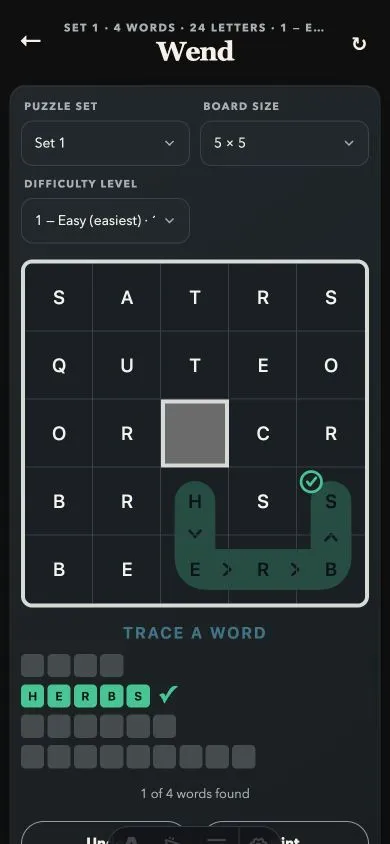
Wend and its Swedish sibling Swend ask the player to divide a letter grid into words of the given lengths. Every open cell belongs to one orthogonally connected word path. The two games share the same path and exact-cover models, with separate word tables for each language.
Generation runs the process backwards. It chooses a symmetric block mask, finds a path through every open cell, cuts that path into lengths between three and ten, and fills the pieces with words.
The first MiniZinc sketch models the geometric part of generation directly. The open cells are nodes in an undirected grid graph. Requiring MiniZinc’s path constraint to include every open node gives one Hamiltonian path from start to finish.
include "globals.mzn";
int: rows;int: columns;set of int: Rows = 1..rows;set of int: Columns = 1..columns;
enum Cells;array[Rows, Columns] of opt Cells: board; % <> marks a block
type Offset = record(int: row, int: column);array[1..2] of Offset: forward = [  (row: 0, column: 1),  (row: 1, column: 0),];
function opt Cells: neighbour(Rows: row, Columns: column, Offset: offset) =  board[      row + offset.row,      column + offset.column  ] default <>;
type Edge = record(Cells: from, Cells: to);array[int] of Edge: edge = [  (      from: deopt(board[row,column]),      to: deopt(neighbour(row, column, offset))  )  | row in Rows, column in Columns, offset in forward  where occurs(board[row,column]) /\        occurs(neighbour(row, column, offset))];set of int: Edges = index_set(edge);
var Cells: start;var Cells: finish;array[Edges] of var bool: used_edge;
constraint path(  from: edge.from,  to: edge.to,  source: start,  sink: finish,  ns: [cell: true | cell in Cells],  es: used_edge);
% A path and its reverse are equivalent.constraint start < finish;
solve satisfy;
The optional board values describe the cell identities and the graph boundary. A block contains <>, and the default <> expression gives an out-of-range lookup the same absent value. The occurs tests therefore reject blocks as well as positions beyond the board. Only rightward and downward offsets are needed because path treats the edges as undirected.
path returns selected edges rather than an ordered cell array. Walking those edges from start to finish recovers the sequence. The native generator constructs that sequence directly, cuts it into the required lengths, may reverse and reorder the pieces, and fills them with words.
The published 5×5 instance below shows those three steps.
1. Make a path
24 open cells
2. Cut into slots
3. Fill with words
The chosen words do not yet make a valid puzzle. The same letters may form other dictionary words, and those candidates may admit a second path cover. A trie finds every dictionary word that can be traced without reusing a cell. The second model then checks whether those candidate paths have another exact cover. Every cell must occur once, and the selected paths must have the given lengths.
set of int: OpenCells;set of int: Lengths = 3..10;enum Candidates;
array[Candidates] of set of OpenCells: candidate_cells;array[Candidates] of Lengths: candidate_length;array[Lengths] of int: required_count;
array[Candidates] of var bool: selected;
constraint forall (cell in OpenCells) (  sum (candidate in Candidates      where cell in candidate_cells[candidate]  ) (selected[candidate]) = 1);
constraint forall (length in Lengths) (  sum (candidate in Candidates      where candidate_length[candidate] = length  ) (selected[candidate]) = required_count[length]);
solve satisfy;
The Gecode checker stops after finding two covers and accepts only a unique decomposition.
Swend’s lexicon starts from SAOL 14 and keeps words supported by the Swedish Kelly list or NyLLex, together with reviewed additions. Wend instead uses a filtered, pinned version of the English Speller Database. Both importers remove palindromes and reversal pairs because a path can be read in either direction.
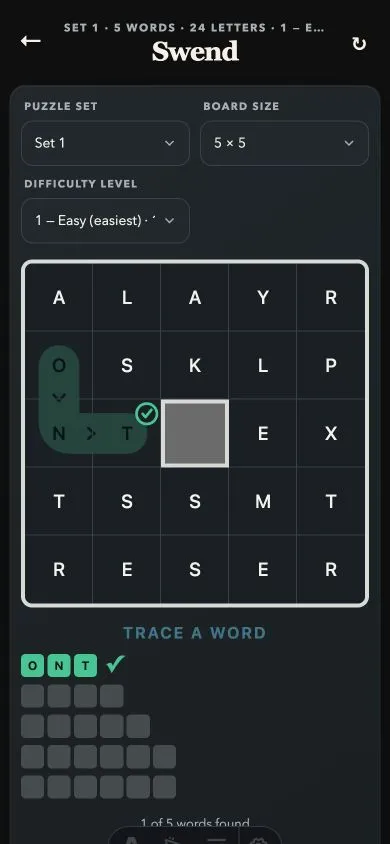
Generated boards must contain turns and straight segments, use all four directions, and survive deduplication under rotations and reflections. Within each board size, the generator first ranks them by the number of traceable dictionary candidates, then by Gecode search nodes and failures. The lower, middle, and upper thirds receive the relative labels Easy, Medium, and Hard. Within each third, the generator favours boards with more mirrored letter pairs while keeping the selection of block masks balanced.
Hints as small propagation systems
Some of the local deductions used to classify puzzles can also explain a player’s next move. Once the solution is known, the easiest hint system would simply reveal part of it. I wanted the hint button to make a deduction when the current state supports one, and to say plainly when it falls back to a reveal.
Sudoku and Queens have explainable hints backed by a small, puzzle-neutral deduction engine. It knows about exact-one groups, capacity-one groups, conflicts, Hall sets,2 and failed-literal reasoning. The last of these uses the same assumption-propagation-failure test as shaving. The engine runs its rules in teaching order and keeps a hint active until the player acts on it. Game-specific adapters translate the general ideas into cells and values for Sudoku, and rows, columns, regions, and attacks for Queens.
Sudoku first reports an incorrect entry. It then tries naked singles, a value with only one place in a row, column, or box, and Hall sets of up to four cells.2 Its last deduction is a small negative-reasoning step. The engine assumes a candidate, propagates forced placements, and rejects the candidate if propagation reaches a conflict. Only when none of these rules applies does it reveal a value from the stored solution.
Queens follows a similar teaching order. It reports attacking or incorrect queens and a cross that hides a solution square. It marks cells directly attacked by placed queens, finds rows, columns, or regions with one candidate left, and uses locked sets when a collection of regions is confined to the same number of rows or columns. Failed-literal reasoning handles the remaining case by tentatively placing a queen and propagating until two forced queens attack or some group loses its last candidate.
The first two examples below are direct deductions. A marks squares that the deduction allows the player to cross out. In the locked-set example, R marks the candidates that justify those actions.
Nonogram uses the same line model for solving and for hints, but keeps the hint implementation local. It first reports a marked square that conflicts with the stored picture. Otherwise it enumerates all line patterns compatible with the current marks and the run clues. If every remaining pattern for a row or column agrees on an unknown square, that square is forced. Only when no line has such a deduction does the hint reveal a square from the stored solution.
The other games use narrower hint finders. Patches recomputes live rectangle domains. Tents replays its line, matching, and failed-assumption deductions, while Loopy reasons about clue saturation, vertex degree, and premature closed subloops. Zip identifies the first wrong turn or continues the known path. Wend and Swend progressively reveal a word. When no deduction applies, the hint says that it is revealing part of the stored solution.
This keeps the distinction visible: a deduction follows from the current state, while a reveal helps the player resume.
Summary
Constraints connect the playable games back to the experiments that started this work. They describe valid solutions and detect alternatives during generation. In some games, they also supply the deductions behind hints.
The generators reach uniqueness in different ways. Nonogram keeps source images that pass a uniqueness check. Sudoku, Loopy, and Patches remove information while preserving a unique answer. Queens, Zip, and Tents repair counterexamples, while Wend and Swend reject alternative covers.
I started with a large Sudoku corpus and wanted to play a few instances. I ended up with nine playable games (so far).
Footnotes
-
Shaving temporarily assigns a value and propagates to a fixpoint. If that assumption fails, the value can be removed without committing to a branch. Bounds shaving tests the current smallest and largest values of a domain; domain shaving tests every remaining value. I described the corresponding MiniZinc preprocessing modes in the LinkedIn Queens benchmarking post. ↩
-
Hall’s theorem gives the matching condition behind
all_different: any set ofkvariables must collectively have at leastkpossible values. If it has exactlyk, those values are reserved for those variables and can be removed from every other domain; fewer thankproves failure. Régin’s matching-based propagator uses the general form of this argument to establish domain consistency. Puget’s bounds propagator looks for the cheaper restricted form given by Hall intervals. ↩ ↩2